
# Misc
# Ranma½
I could have done with a bit more experience for this one. And a few more pieces of wonderfully obscure trivia…
# Variable-length UTF-8
The table shows how the bits of a Unicode code point are distributed across the bytes of its UTF-8 encoding:
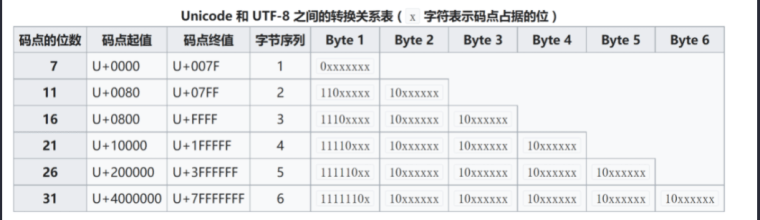
Read the x bits in a row from left to right to recover the code point.
For example, the Hebrew letter א has code point U+05D0. Its UTF-8 bytes are D7 90. Here’s the conversion:
- U+05D0 falls between U+0080 and U+07FF, so it uses the two-byte pattern
110xxxxx 10xxxxxx. - In binary,
05D0is10111010000when written in eleven bits. - Fill the first five and last six positions:
11010111 10010000.
Those bytes are D7 90 in hex. For the reverse conversion, remove the prefixes and join the remaining bits.
# How the puzzle hides information
A UTF-8 character can occupy one to four bytes. Opening the challenge file as ordinary text produced mostly gibberish. The trick is that the puzzle uses the shape of a longer encoding for a character that should have been stored in a single byte.
Take A: its code point is 0x41 , or 1000001 in binary. To fit it into the eleven payload bits of a two-byte pattern, pad it to 00001000001 . Inserting those bits into the pattern gives 11000001 10000001 , or C1 81. This is an overlong sequence and isn’t valid UTF-8. Reading its payload bits by hand explains how the challenge encodes the letter despite an ordinary decoder rejecting it.
# Solving it
There were a few ways to inspect the file. Vim worked, and so did WinRAR’s View command, of all things:

I also tried reading the bytes with Python:
import binascii | |
x,y,z=[],[],[] | |
with open("Ranma","rb") as f: | |
try: | |
while 1: | |
Str = f.read(1) | |
if not Str:break | |
x.append(binascii.hexlify(Str)) | |
finally: | |
f.close() # 读文件,将 16 进制字串存入 list x | |
for i in range(len(x)): | |
if int(x[i],16)<128: | |
y.append(chr(int(x[i],16))) # 小于 128 的直接 chr () 转换 ASCII 码 | |
if int(x[i],16)>127: | |
y.append(bin(int(x[i],16))) # 大于 128 的转换为二进制分析 | |
for i in range(len(y)): | |
if '0b110' in y[i]: # 如果是第二行的情况 | |
y[i]=chr(int(y[i][5:]+(y[i+1])[4:],2)) | |
if '0b1110' in y[i]: # 如果是第三行的情况 | |
y[i]=chr(int(y[i][6:]+(y[i+1])[4:]+(y[i+2])[4:],2)) | |
for i in range(len(y)): | |
if '0b' not in y[i]: # 去除多余项并合并 | |
z.append(y[i]) | |
print(''.join(z)) |
That gave me:
KGR/QRI 10646-1 zswtqgg d tnxcs tsdtofbrx osk ndnzhl gna Ietygfviy Idoilfvsu Arz (QQJ) hkkqk maikaglvusv ubyp cw ekg krzyj'o kitwkbj alypsdd. Wjs rzvmebrwoa duwcuosu pqecgqamo cw ekg IFA, uussmpu, ysum aup qfxschljyk swks pcbb khxnsee drdoqpgpwfyv cbg xeupctzou, oql gneg ylv nsg bb zds upygzrxzkjh fq XVT-8, wpr uxxvnw qt wpvy isdz. XVT-8 kif zds tsdtofbrxegktf qt szryafmtqi hkm sahz LD-DUQLQ egjuv, auqjllvtc qfxschljvrehp hlvv iqyk omjehog, sieyafj lqf cwprx ocwezcfh bugp fvwb qb XA-NYYWZ gdniha oap oip wtoqacgnsee wq cwprx rocfhu.
HTTPZB{QFOLP6_KRZ1Q}
It looked like a Vigenère ciphertext. I found two ways to proceed:
- Use Automatic decryption in the dCode Vigenère tool.
- Recover the key the way the official write-up intended. List the encoded character lengths in order. One byte stands for a dot, two for a dash and three for a separator. Read the result as Morse code to get the key. I’m not sure how long it would have taken me to think of that one ( ̄▽ ̄)".

Flag: TQLCTF{CODIN6_WOR1D}